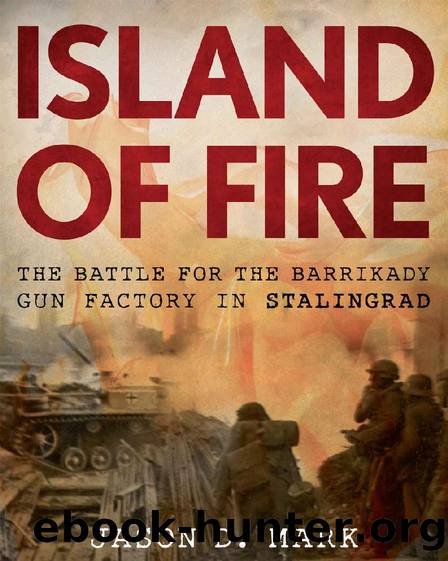
Island of Fire: The Battle for the Barrikady Gun Factory in Stalingrad by Jason Mark
Author:Jason Mark [Mark, Jason]
Language: eng
Format: epub
ISBN: 9780811766197
Publisher: Stackpole Books
Published: 2018-04-30T22:00:00+00:00
12 December, 1942
Fugenfirovâs artillery grouping began to fire on the German front between 138th and 95th Rifle Divisions from 12 December, 1942. They had orders to annihilate German firing points up to the depth of 300 metres from the Volga bank while offensive actions were being organised by 138th and 95th Rifle Divisions to clear the Germans located along the Volga bank between them. The artillery bombardment began at 0700 hours. The ten 122mm howitzers fired 2 shells per minute each, for a total of 1080 rounds, while the twelve 76mm guns and twelve 120mm mortar each fired a shell per minute, also for a total of 1080. Chuikov would later write:
We could not destroy the enemy who had reached the Volga in the area of the Barrikady factory merely by attacks with our infantry regiments: we had neither tanks nor reserves. What were we to do? How could we help Lyudnikovâs division?
The artillery we had installed on the left bank of the Volga now came to our aid. To use this artillery we did not have to ferry ammunition across the Volga. We decided to wipe out the enemy by artillery fire. But to do this involved difficulties, which seemed insuperable: we needed to organise absolutely accurate fire on every enemy position, we needed artillery and mortar marksmen. We had such marksmen, but to correct their fire from the right bank was difficult â telephone links were being continually broken by the ice, and radio communication was weak and unreliable. Studying all these factors, we worked out and started to implement the following method of destroying the enemy who had broken through to the Volga.
We marked out the area occupied by the enemy from north and south and from the Volga to the farthest point in the front-line, indicating landmarks which were clearly visible from the left bank. This gave us a 650-850 yard corridor occupied by the Germans. Our artillerymen, seeing this corridor clearly, could fire accurately at the enemyâs firing positions.
Spotters on the right bank watched the firing. They indicated and watched the targets, and errors in the gunnersâ aim. All this was communicated to the artillery observation posts, and then in turn transmitted to the firing positions.
In preparation for the artillery fire, some of the most exposed Soviet positions were pulled back. The war diary of 138th Rifle Division even reported that âthe left flank group (Rolik) was moved 100 metres in a northern direction into the area of the waterworks on the bank of the Denezhnaya Volozhka channelâ. Not all of the fire landed accurately. The combat journal of 650th Rifle Regiment records that âarmy artillery lay down powerful artillery fire along our forward defensive line and on enemy emplacements. Destroyed by this artillery fire were two of our own dug-outs and three enemy emplacements in the area around the transformer hutâ. Fortunately for the regiment, there were no fatalities. Total losses for the day were two men wounded.
The beginning of the Soviet attritional fire did not have much impact on Hauptmann Rettenmaier:
There is nothing new to report.
Download
This site does not store any files on its server. We only index and link to content provided by other sites. Please contact the content providers to delete copyright contents if any and email us, we'll remove relevant links or contents immediately.
Personalized inhaled bacteriophage therapy for treatment of multidrug-resistant Pseudomonas aeruginosa in cystic fibrosis by unknow(181719)
CONSORT 2025 statement: updated guideline for reporting randomized trials by unknow(90147)
Critical evaluation of the ProfiLER-02 study design and outcomes by Vivek Subbiah & Razelle Kurzrock(89750)
Cardiac gene therapy makes a comeback by Oliver J. Müller & Susanne Hille & Anca Kliesow Remes(89510)
Whisky: Malt Whiskies of Scotland (Collins Little Books) by dominic roskrow(74452)
Unveiling the design rules for tunable emission in graphene quantum dots: A high-throughput TDDFT and machine learning perspective by Şener Özönder & Mustafa Coşkun Özdemir & Caner Ünlü(50905)
A yeast-based oral therapeutic delivers immune checkpoint inhibitors to reduce intestinal tumor burden by unknow(40277)
Covalent hitchhikers guide proteins to the nucleus by Alexander F. Russell & Madeline F. Currie & Champak Chatterjee(40220)
Meet the Authors: Christopher R. Mansfield and Emily R. Derbyshire by Christopher R. Mansfield & Emily R. Derbyshire(40104)
Alkaline-earth metals promote propane dehydrogenation with carbon dioxide through geometric effects: Altering the reaction pathway by unknow(32742)
Induced iron vacancies boosting FeOOH loaded on sustainable Fenton-like collagen fiber membrane for efficient removal of emerging contaminants by unknow(32522)
Efficient electric-field-assisted photochemical conversion of methane to n-propanol exclusively over penetrated TiO2Ti hollow fibers by Guanghui Feng(32460)
Bi2SiO5 nanosheets as piezo-photocatalyst for efficient degradation of 2,4-Dichlorophenol by Hangyu Shi & Yifu Li & Lishan Zhang & Guoguan Liu & Qian Zhang & Xuan Ru & Shan Zhong(32400)
A novel NDIPTA organic heterojunction photocatalyst with built-in electric field for efficient hydrogen production by Jiahui Yang & Baojun Ma & Yongfa Zhu(32372)
Enhanced conversion of methane to liquid-phase oxygenates via hollow ferrite nanotube@horseradish peroxidase based photoenzymatic catalysis by Jun Duan & Shiying Fan & Xinyong Li & Shaomin Liu(32339)
Ordered macroporous superstructure of defective carbon adorned with tiny cobalt sulfide for selective electrocatalytic hydrogenation of cinnamaldehyde by Xiao-Shi Yuan & Sheng-Hua Zhou & San-Mei Wang & Wenbo Wei & Xiaofang Li & Xin-Tao Wu & Qi-Long Zhu(32263)
What's Done in Darkness by Kayla Perrin(27155)
Topological analysis of non-conjugated ethylene oxide cored dendrimers decorated with tetraphenylethylene: Insights from degree-based descriptors using the polynomial approach by A Theertha Nair & D Antony Xavier & Annmaria Baby & S Akhila(26543)
Investigation of mechanical and self-healing properties of hydroxyl-terminated polybutadiene functionalized with 2-ureido-4-pyrimidinone by Mohsen Kazazi & Mehran Hayaty & Ali Mousaviazar(26469)
